RSDᵣ (repeatability RSD) is the relative standard deviation of results obtained under repeatability conditions: the same method, laboratory, operator and equipment over a short time. RSDᴿ (reproducibility RSD) is the relative standard deviation under reproducibility conditions, where different laboratories measure the same material. Because it includes between-laboratory differences, RSDᴿ is larger than RSDᵣ.
Intermediate precision sits between the two. It is measured in one laboratory, but over days, analysts or instruments. The sections below define each condition, show the notation, and work through the calculations with example data.
Three Precision Conditions
Precision always depends on what is allowed to change while the measurements are made. The international metrology vocabulary (JCGM 200:2012, the VIM) and the ISO 5725 series define three sets of conditions.
| Condition | What stays the same | What changes | Typical symbol |
|---|---|---|---|
| Repeatability | Procedure, laboratory, operator, measuring system, operating conditions | Only the replicate measurements, made over a short period | sᵣ, RSDᵣ |
| Intermediate precision | Procedure and laboratory | Time (days or weeks), and often analyst, instrument, reagent lot or calibration | sI, RSDI |
| Reproducibility | Procedure and the test material | Laboratory, operators, equipment and time | sᴿ, RSDᴿ |
Each step down the table adds more sources of variation. Repeatability is the smallest spread a method can show. Reproducibility is the spread a user of the method should expect when results come from different laboratories.
The VIM defines a repeatability condition as the same procedure, operators, measuring system, operating conditions and location, with replicate measurements “over a short period of time.” An intermediate precision condition keeps the procedure and location but runs “over an extended period of time,” and may include new calibrations, operators or measuring systems. A reproducibility condition “includes different locations, operators, measuring systems.”
ICH Q2(R2), the pharmaceutical validation guideline, uses the same three levels: repeatability is precision “under the same operating conditions over a short interval of time,” intermediate precision “expresses intra-laboratory variations,” and reproducibility “expresses the precision between laboratories.”
Different fields use different names for the same ideas. The Eurachem validation guide lists within-run, within-batch and intra-assay precision as other names for repeatability, and within-laboratory reproducibility, between-run and inter-assay variation as other names for intermediate precision.
A precision figure without its conditions is incomplete. “RSD = 1.2%” could describe six injections made in ten minutes or the results of twelve laboratories, and those two numbers mean very different things.
Notation: Lowercase r and Uppercase R
The subscript carries the meaning, so it is worth getting right.
- sᵣ and RSDᵣ: repeatability standard deviation and repeatability RSD (lowercase r)
- sᴿ and RSDᴿ: reproducibility standard deviation and reproducibility RSD (uppercase R)
- sL: the between-laboratory standard deviation, the extra spread caused by differences among laboratories
- r and R on their own: the repeatability limit and reproducibility limit, explained later
In plain text, RSDr and RSDR are common when subscripts are unavailable. Because the only difference is the case of one letter, spell out “repeatability” or “reproducibility” the first time you use either symbol in a report.
Both RSD values use the same basic formula as any RSD:
The difference is entirely in how the standard deviation is estimated, which depends on the design of the experiment.
Why RSDᴿ Is Larger: Variance Components
Standard deviations do not add, but variances do. Reproducibility variance is the sum of the within-laboratory (repeatability) variance and the between-laboratory variance:
This is the model used in ISO 5725-2. The between-laboratory term collects everything that differs from one laboratory to another: calibration standards, instruments, analysts, environmental conditions and local interpretation of the method.
Intermediate precision follows the same logic inside one laboratory. Replace the between-laboratory term with a between-day (or between-run) term, and the intermediate precision variance is the repeatability variance plus that extra component.
Worked Example 1: A Collaborative Study
Five laboratories each measure the content of a major component in the same homogeneous material, three times each under repeatability conditions. The results are in g/100 g.
| Laboratory | Results | Mean | Sample SD |
|---|---|---|---|
| A | 44.8, 45.3, 45.1 | 45.067 | 0.2517 |
| B | 45.9, 45.4, 46.1 | 45.800 | 0.3606 |
| C | 44.5, 45.0, 44.7 | 44.733 | 0.2517 |
| D | 45.6, 45.0, 45.4 | 45.333 | 0.3055 |
| E | 46.0, 45.5, 45.9 | 45.800 | 0.2646 |
The overall mean of all 15 results is 45.347 g/100 g. With p = 5 laboratories and n = 3 replicates each, a one-way analysis of variance splits the variation into two parts.
Step 1: Within-laboratory variation. Add the sums of squared deviations inside each laboratory: 0.12667 + 0.26000 + 0.12667 + 0.18667 + 0.14000 = 0.84000. There are p(n − 1) = 10 degrees of freedom, so the within-laboratory mean square is 0.08400.
Step 2: Between-laboratory variation. The mean square between laboratories uses the laboratory means: n × Σ(lab mean − overall mean)² / (p − 1) = 3 × 0.86578 / 4 = 0.64933. The between-laboratory variance is:
Step 3: Reproducibility. Add the two variance components:
The reproducibility RSD is almost twice the repeatability RSD. Most of the extra spread comes from laboratories C and B, whose means differ by more than 1 g/100 g, far more than the scatter within any one laboratory.
In this example RSDᵣ is about 0.56 of RSDᴿ. AOAC’s Appendix F guidance notes that in the interlaboratory studies behind the Horwitz relationship, within-laboratory RSDs “were found to be typically 1/2 to 2/3 the among-laboratory relative standard deviations,” so this ratio is realistic.
Notice that the within-laboratory mean square, 0.08400, is exactly the pooled variance of the five laboratories: the sums of squares added together and divided by the total degrees of freedom. The repeatability standard deviation from a collaborative study is a pooled standard deviation, which is why the pooled RSD guide uses the same weighting by n − 1.
If the between-laboratory mean square ever comes out smaller than the within-laboratory mean square, the formula gives a negative variance. That simply means no between-laboratory effect was detected. The usual practice is to set sL² to zero, so that sᴿ equals sᵣ.
Why not just calculate the RSD of all 15 results?
Treating all 15 results as one data set gives an RSD of 1.09%. That figure mixes the two sources of variation without separating them, and it slightly underestimates RSDᴿ in this design because it does not weight the between-laboratory component correctly. The ANOVA approach gives both RSDᵣ and RSDᴿ from the same data and is the approach standardized in ISO 5725-2.
Real collaborative studies also screen the data for outlying laboratories before the calculation, typically using Cochran’s test for variances and Grubbs’ test for means. The worked example assumes those checks have been passed.
Worked Example 2: Intermediate Precision in One Laboratory
A single laboratory wants to know how its results vary over time, not just within one run. An analyst measures a control sample in triplicate on four different days. Results are in % label claim.
| Day | Results | Mean | Sample SD |
|---|---|---|---|
| 1 | 101.2, 100.8, 101.5 | 101.167 | 0.3512 |
| 2 | 99.9, 100.4, 100.1 | 100.133 | 0.2517 |
| 3 | 101.8, 102.1, 101.6 | 101.833 | 0.2517 |
| 4 | 100.6, 100.2, 100.9 | 100.567 | 0.3512 |
The calculation has the same structure as Example 1, with days in place of laboratories. The overall mean is 100.925.
- Within-day mean square: 0.74667 / 8 = 0.09333, so sᵣ = 0.3055 and RSDᵣ = 0.30%
- Between-day mean square: 1.63861, so the between-day variance is (1.63861 − 0.09333) / 3 = 0.51509, and sday = 0.7177
- Intermediate precision: sI = √(0.09333 + 0.51509) = 0.7800, so RSDI = 0.77%
Within a day the method is very precise, at 0.30%. Across days the spread more than doubles, which tells the laboratory that something changing from day to day, such as standard preparation or instrument calibration, contributes more variation than the measurement itself. That is useful information that a single repeatability figure would hide.
Repeatability and Reproducibility Limits
RSD values describe spread. To judge whether two individual results agree, the ISO 5725 series and the Eurachem guide use limits based on the same standard deviations:
Eurachem writes the repeatability limit as r = √2 × t × sᵣ, where √2 accounts for taking the difference of two results and t is the two-tailed Student t-value. With many degrees of freedom, t is close to 2 at 95% confidence, which gives the familiar approximation r = 2.8 × sᵣ. It is the largest absolute difference expected between two single results with about 95% probability.
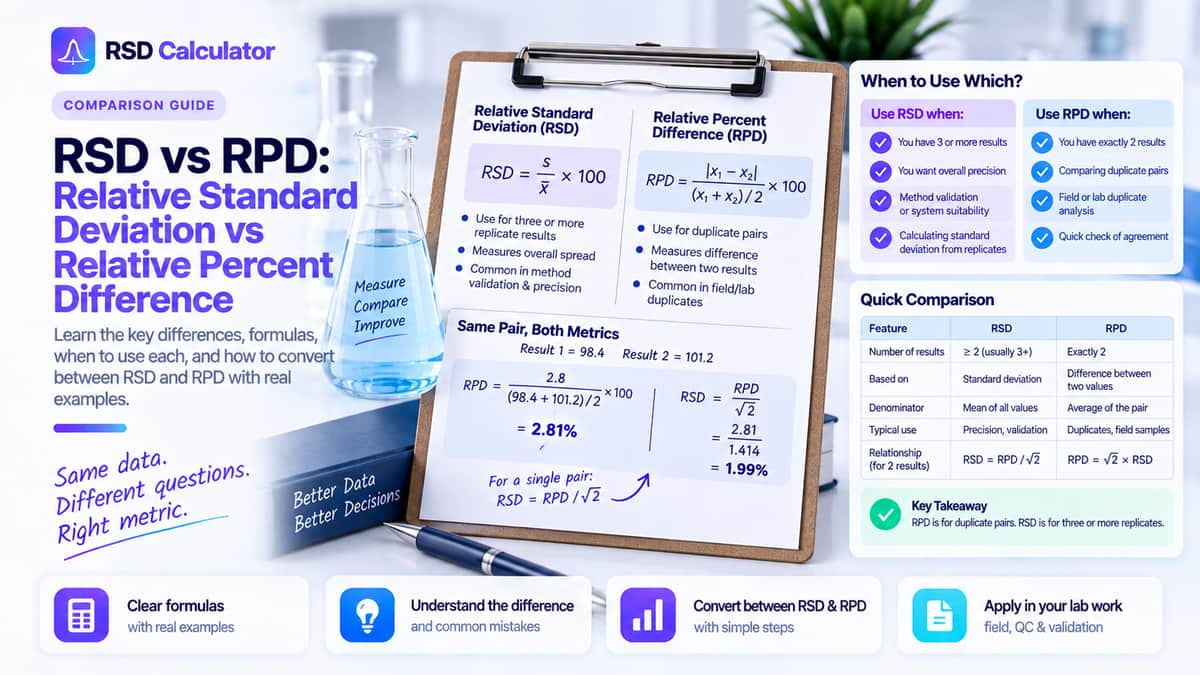
The same logic applies to duplicate checks. A duplicate pair’s relative percent difference should usually stay below about 2.8 times the repeatability RSD, a link explained further in RSD vs RPD.
Using Example 1: r = 2.8 × 0.2898 = 0.81 g/100 g and R = 2.8 × 0.5220 = 1.46 g/100 g. Two results from the same laboratory under repeatability conditions should rarely differ by more than 0.81 g/100 g. Results from two different laboratories should rarely differ by more than 1.46 g/100 g. A larger difference is a signal to investigate, not proof of an error.
Comparing the Conditions Side by Side
| Aspect | Repeatability | Intermediate precision | Reproducibility |
|---|---|---|---|
| Where | One laboratory | One laboratory | Several laboratories |
| Time scale | Minutes to hours | Days to months | Any |
| Typical study | Replicates in one run | Replicates on several days, analysts or instruments | Collaborative study or proficiency testing |
| Example result (this article) | RSDᵣ = 0.64% or 0.30% | RSDI = 0.77% | RSDᴿ = 1.15% |
| Answers the question | How precise is the method at its best? | How consistent is this laboratory over time? | How well do laboratories agree with each other? |
Interpreting RSDᵣ and RSDᴿ
Three checks help put the numbers in context.
Compare the ratio. RSDᵣ well below half of RSDᴿ suggests a large between-laboratory component. That usually points to differences in calibration, sample preparation or interpretation of the method, which can often be fixed by tightening the written procedure.
Compare with predicted precision. For chemical analysis, the Horwitz equation predicts a typical RSDᴿ from the analyte concentration alone. The ratio of observed to predicted RSDᴿ, the HorRat, is a common check on whether a collaborative study’s precision is typical. See Horwitz Equation and HorRat for the calculation.
Check the concentration level. Precision usually changes with concentration, so RSDᵣ and RSDᴿ are reported per level. A single RSDᴿ quoted for a method is incomplete unless the concentration it applies to is also given.
Common Mistakes
- Calling day-to-day RSD “repeatability.” Results collected across several days include between-day variation. That is intermediate precision.
- Estimating reproducibility from laboratory means only. The standard deviation of the laboratory means is not sᴿ. It ignores the repeatability component and, in this design, is inflated by it in a way that ANOVA corrects.
- Lumping all results into one data set. It merges the components and, as Example 1 shows, does not match either RSDᵣ or RSDᴿ.
- Drawing conclusions from very few laboratories. Between-laboratory variance estimated from two or three laboratories is extremely uncertain. Formal collaborative study protocols call for considerably more.
- Mixing concentration levels. Pooling repeatability across levels is only valid when the RSD is roughly constant. The pooled RSD guide explains how to check that.
Terminology Traps
A few uses of these words do not match the definitions above, and they cause real confusion when results are compared.
- “Reproducibility” for results from different days. Many papers report “reproducibility” from one analyst on several days in one laboratory. Under ICH Q2(R2) and ISO 5725 that is intermediate precision, because reproducibility requires different laboratories.
- Reproducibility in gauge R&R studies. In manufacturing measurement system analysis, “reproducibility” usually means the variation between operators or appraisers only. That corresponds to the between-group component (sL in this article), not to the total sᴿ.
- Different methods. The VIM allows reproducibility conditions to include different measurement procedures. In method validation, and in ISO 5725, reproducibility means the same method used in different laboratories. Eurachem notes that the term may also describe laboratories using different methods to measure the same quantity, so state which you mean.
- Other meanings of “RSDR”. In some statistics software, RSDR is an abbreviation for an outlier-resistant standard deviation of regression residuals, which has nothing to do with precision conditions. Spell out the term the first time.
Where These Terms Appear
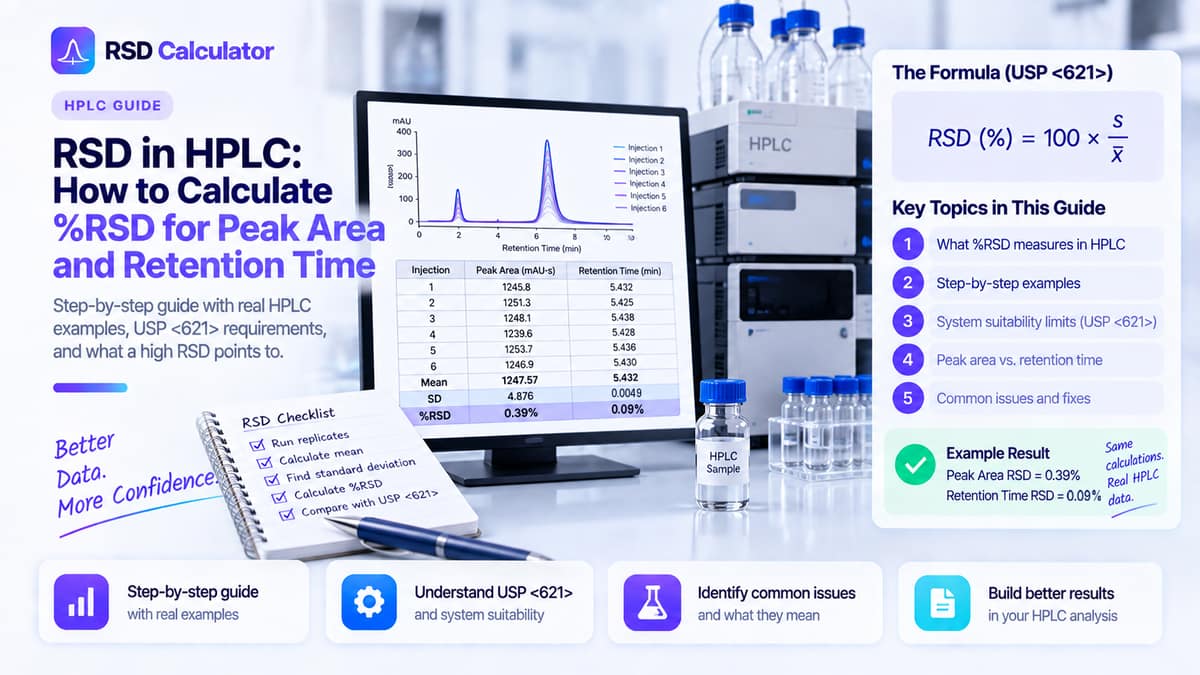
In pharmaceutical analysis, ICH Q2(R2) treats repeatability, intermediate precision and reproducibility as the levels of precision in method validation, with reproducibility reserved for inter-laboratory studies. It notes that reproducibility is usually not required for a regulatory submission but should be considered when a procedure is standardised, for example for a pharmacopoeia, or run at several sites. The broader validation context is covered in Using RSD in Quality Control and Method Validation. For a chromatography-specific view, RSD in HPLC shows how injection repeatability fits into system suitability.
For individual data sets, the RSD Calculator gives the mean, sample SD and %RSD of each laboratory or day, which are the building blocks of the calculations above.
Frequently Asked Questions
Is RSDR always larger than RSDr?
It should be, because reproducibility conditions include all the variation present under repeatability conditions plus the differences between laboratories. The reproducibility variance equals the repeatability variance plus the between-laboratory variance. In a small study, random chance can occasionally make the estimates look closer than they really are.
Is intermediate precision the same as reproducibility?
No. Intermediate precision is measured within one laboratory over longer periods, with changes such as different days, analysts or instruments. Reproducibility involves different laboratories. Intermediate precision usually falls between repeatability and reproducibility.
What is the difference between RSDr and the repeatability limit r?
RSDr is the repeatability standard deviation expressed as a percentage of the mean. The repeatability limit r = 2.8 × sr is the largest difference expected between two single results under repeatability conditions, with about 95% probability. RSDr describes spread; r is used to judge whether two results agree.
Can I calculate reproducibility RSD in my own laboratory?
Not in the strict sense. Reproducibility requires results from different laboratories, usually from a collaborative study or proficiency testing scheme. Within one laboratory you can estimate repeatability and intermediate precision.